


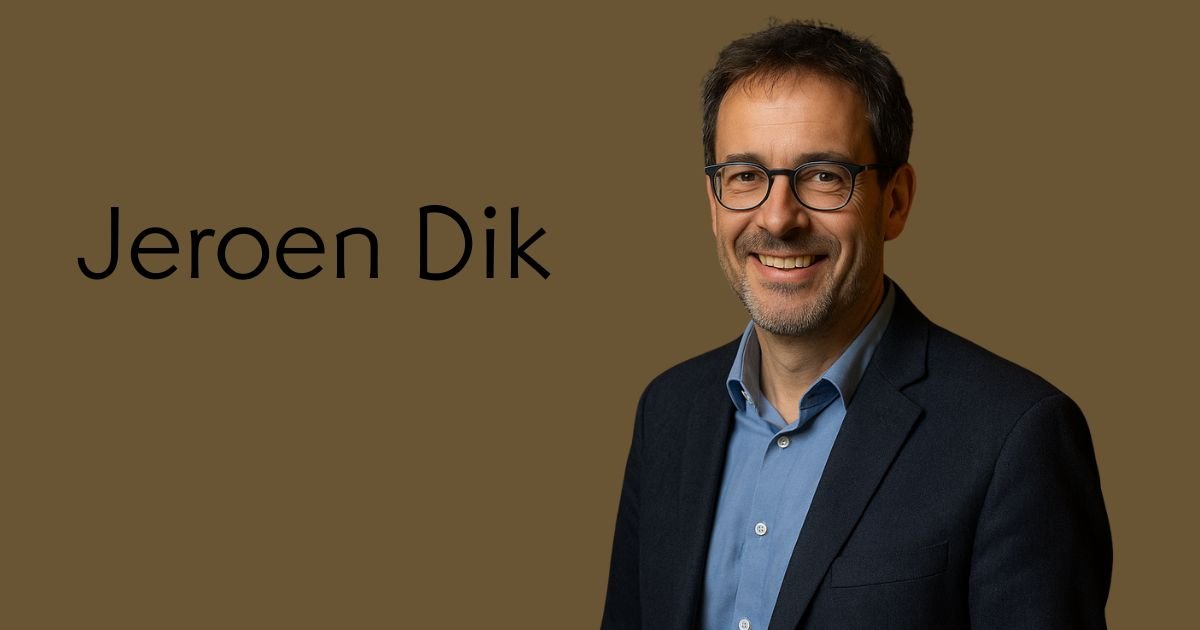
Art and science have long been seen as two separate worlds—one driven by creativity and emotion, the other by logic and evidence. Yet, every once in a while, a person comes along who bridges that gap beautifully. Jeroen Dik is one of those rare individuals. As a professor and researcher, he’s known worldwide for merging scientific innovation with artistic insight to uncover the hidden layers of history within paintings. His work doesn’t just transform how we look at art; it reshapes our understanding of how science can help preserve and interpret culture.
Who Is Jeroen Dik?
Jeroen Dik is a leading figure in the field of technical art history, a discipline that blends chemistry, physics, and art restoration. He serves as a professor at TU Delft (Delft University of Technology) in the Netherlands, where he leads pioneering research projects aimed at revealing the secrets hidden beneath centuries-old artworks.
- His main expertise lies in using non-invasive imaging technologies to analyze historical paintings.
- Dik’s innovative methods allow art historians to look deeper into masterpieces without physically damaging them.
What makes Jeroen Dik’s approach fascinating is his ability to combine deep scientific understanding with a passion for visual art. This blend allows him to see not just the chemical makeup of paint—but the soul behind every brushstroke.
The Bridge Between Art and Science
In a world where most people stay within the lines of their discipline, Jeroen Dik thrives in the space between. He’s built his career on proving that art and science can coexist in harmony.
- Using scientific instruments, he explores how pigments age, react, and sometimes even transform over time.
- Through this lens, Dik helps museums and restorers make informed decisions about conservation.
His work is living proof that innovation doesn’t just happen in labs or studios—it happens where imagination meets evidence. By fusing scientific precision with artistic curiosity, Dik has opened new doors for both communities.
Educational and Professional Journey
The path that led Jeroen Dik to global recognition was rooted in his early fascination with both chemistry and art. After completing his studies, he joined TU Delft, where he found the perfect environment to explore both passions simultaneously.
At Delft, he began collaborating with art museums and research institutes across Europe. His ability to translate complex data into meaningful artistic insight quickly gained attention. Over the years, Dik has worked with institutions like:
- The Rijksmuseum – the national museum of the Netherlands
- The Van Gogh Museum – where his research revealed hidden works under famous paintings
- The Mauritshuis – home of Vermeer’s “Girl with a Pearl Earring”
These collaborations solidified his reputation as a scientific detective of art.
The Groundbreaking Discoveries
One of Jeroen Dik’s most famous breakthroughs came when he used macro X-ray fluorescence (XRF) scanning to uncover a hidden portrait beneath Vincent van Gogh’s “Patch of Grass.” The discovery shocked the art world—it was as if science had given us a time machine into the artist’s process.
But that wasn’t his only success:
- Dik’s team also revealed previously unseen layers in Rembrandt’s paintings, shedding light on how the master composed his works.
- His research has unveiled pigment patterns and color compositions that were impossible to detect with traditional restoration tools.
Each discovery reinforces a simple truth—behind every masterpiece lies another story waiting to be told.
The Technologies Behind His Work
The secret to Jeroen Dik’s success lies in the technology he uses and the creativity with which he applies it.
Some of the main techniques include:
- Macro X-ray Fluorescence (XRF) Scanning: Allows mapping of pigments beneath the surface.
- Hyperspectral Imaging: Captures color data invisible to the human eye.
- 3D Microscopy: Offers a detailed topography of paint layers.
- Raman Spectroscopy: Identifies the molecular composition of pigments.
What’s unique is how Dik integrates these technologies. He doesn’t just use them for technical analysis—he uses them to tell stories. By merging data visualization with artistic interpretation, he helps both scientists and artists appreciate each other’s worlds.
Impact on Art Restoration and Conservation
Before Jeroen Dik’s innovations, art restoration was largely based on experience and intuition. Now, it’s guided by data-driven insight. His research allows restorers to:
- Understand the chemical stability of pigments before choosing conservation materials.
- Avoid damaging priceless works during restoration.
- Detect earlier repairs or overpainting done by previous conservators.
This precision ensures that artworks are preserved in their most authentic form. Thanks to Jeroen Dik, restoration has evolved from a craft into a science-backed discipline.
Global Influence and Recognition
Over the years, Jeroen Dik has earned international recognition for his contributions to both science and the arts. His research is widely cited, and he has published numerous papers in academic journals.
- He regularly collaborates with universities and research institutions across Europe and the U.S.
- Dik’s projects are often featured in exhibitions, documentaries, and museum showcases.
His influence extends beyond the lab. Many young researchers and artists now look to him as an inspiration—a figure who proves that the pursuit of knowledge doesn’t have to fit neatly into one category.
The Future of Art and Science According to Jeroen Dik
Looking forward, Jeroen Dik continues to explore new ways to bridge art and science. He believes that the future lies in combining AI, machine learning, and digital imaging to automate and refine art analysis.
Imagine a world where an algorithm, trained on thousands of paintings, can detect the hand of a specific artist—or even reconstruct faded colors from centuries ago. That’s the future Dik envisions.
His work is a reminder that innovation is endless, especially when passion and precision come together. As he continues to push the boundaries of art technology, Dik stands as a symbol of what can be achieved when curiosity drives both brush and microscope.
Conclusion
In the grand tapestry of art and science, Jeroen Dik is the thread that weaves the two worlds together. His pioneering work doesn’t just restore paintings—it restores our connection to history. By combining the curiosity of an artist with the precision of a scientist, he has redefined what it means to study and preserve culture.
