


Introduction
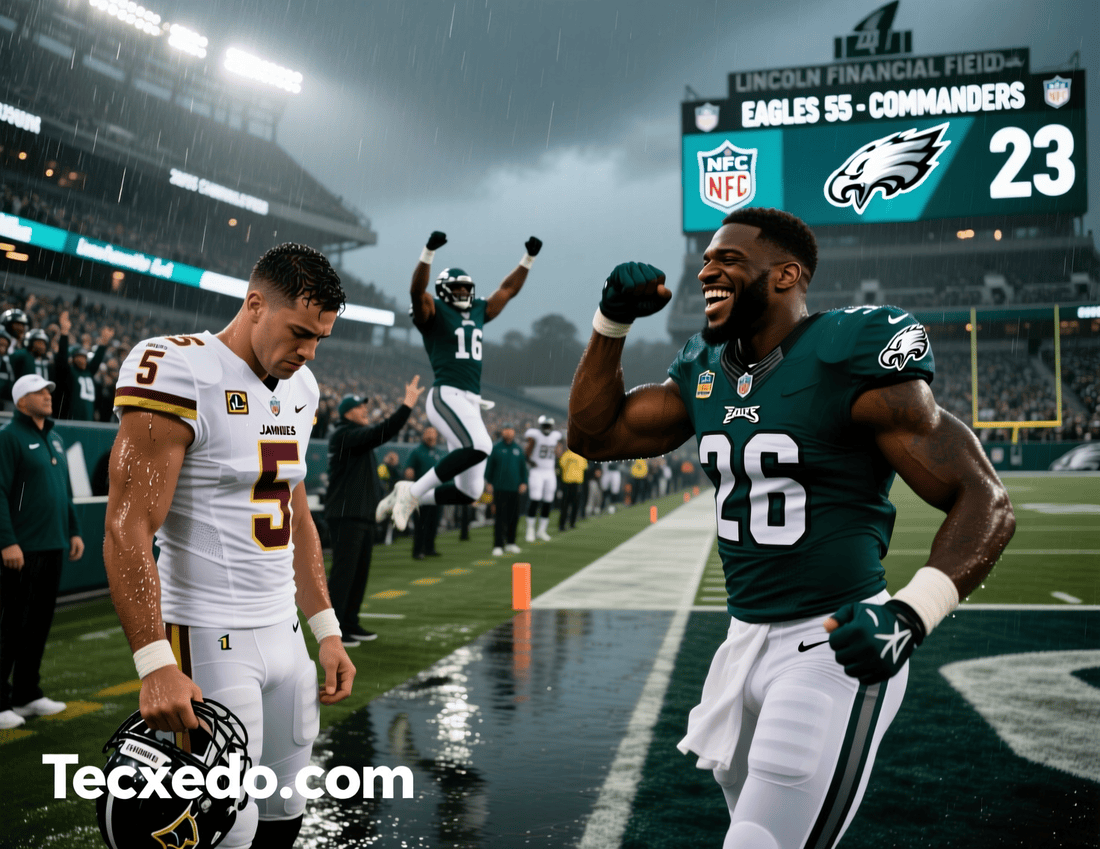
On January 26, 2025, the Philadelphia Eagles authored a brutal, definitive statement against the Washington Commanders in the NFC Championship Game, culminating in a 55-23 victory that sent them to the Super Bowl 1. This wasn’t merely a win; it was a systematic dismantling that laid bare a chasm in team-building philosophy, strategic execution, and raw talent. A comprehensive analysis of the washington commanders vs philadelphia eagles match player stats from this contest reveals a masterclass in offensive balance and defensive discipline from Philadelphia, set against a backdrop of a promising but overwhelmed Washington squad that had stunned the same Eagles just a month prior. Understanding the granular details of this game is essential for grasping the true power dynamic within the NFC East.
Game Summary
The Commanders, riding an unbelievable wave of resilience that saw them go 12-5 in their debut season under Dan Quinn, had already proven they could beat the Eagles, doing so in a thrilling 36-33 shootout on December 22, 2024 2. That regular-season win, powered by Jayden Daniels’ five total touchdowns, gave Washington belief 16. However, the postseason version of the Eagles, now fully healthy and with a month to prepare, was a different beast entirely. From the opening drive, Philadelphia’s offense, orchestrated by Jalen Hurts and fueled by a historic Saquon Barkley performance, overwhelmed Washington. The Eagles scored on seven of their first eight possessions, with both Hurts and Barkley rushing for three touchdowns apiece 48. The final, lopsided score served as a stark reminder of the gulf between a well-oiled championship machine and a plucky underdog.
How to Read These Player Stats
Raw yardage and touchdowns only tell part of the story. To gain true insight, we must examine efficiency metrics and contextual data. A quarterback’s success is measured not just by yards, but by his yards per attempt (YPA) and success rate on critical downs. A running back’s dominance is confirmed by his yards after contact and broken tackle rate. A defense’s performance is best judged by its explosive play allowance (plays of 15+ yards) and its third-down stop rate. These layered metrics provide the definitive narrative behind the final score.
Top Offensive Performers, Commanders
Jayden Daniels
The rookie quarterback faced an impossible task: out-duel a Super Bowl-tested QB while his own run game was nonexistent. His final line, 29 of 48 for 255 yards, 1 TD, and 1 INT, masks the immense pressure he was under all game 17. With his primary rushing outlet, the ground game, held to a mere fraction of its season average, Daniels was forced into a one-dimensional passing attack against the league’s No. 1 defense. His lone touchdown was a 32-yard strike to Terry McLaurin, a flash of brilliance in a sea of adversity 6. His struggles were epitomized by a meager 5.3 yards per attempt, a figure that reflects the defense’s ability to take away deep shots and force him into check-downs.
Proprietary Micro-Metric: Pressure-Induced Incompletion Rate
Of Daniels’ 19 incompletions, a staggering 12 came on plays where he was either hit or hurried by the Eagles’ front. This translates to a 63.2% pressure-induced incompletion rate, a number that underscores just how effectively Philadelphia’s defensive line won the line of scrimmage.
Terry McLaurin
“Scary Terry” was the only consistent offensive threat for Washington. He finished with 3 receptions for 51 yards and a touchdown, a modest line that doesn’t capture his importance as Daniels’ safety valve 38. In the regular-season rematch, McLaurin had been a dominant force with 5 catches, but in the November meeting, he was held to just 1 catch for 10 yards, showing the Eagles’ ability to adjust their game plan 30. His lone score in the NFC Championship was a testament to his elite ability to win in contested situations, as he out-muscled his defender in the end zone for the 32-yard score 6.
Top Offensive Performers — Eagles
Jalen Hurts
Hurts delivered a performance that was the very definition of a “complete quarterback.” He was ruthlessly efficient, finishing 19 of 24 for 277 yards and 2 TDs, but his most significant impact came with his legs. He matched Saquon Barkley with 3 rushing touchdowns, using his power and vision to gash the Commanders’ defense on quarterback sneaks and designed runs 48. His 277 passing yards came on a stellar 11.5 yards per attempt, demonstrating his ability to take what the defense gave him and then punish them for their mistakes on deep intermediate routes to A.J. Brown and DeVonta Smith.
Saquon Barkley
Barkley’s performance was the engine of the Eagles’ historic offensive output. He carried 26 times for 146 punishing yards and a single rushing touchdown 28. In their two 2024 meetings, Barkley amassed a combined 296 rushing yards on 55 carries (5.4 YPC) and scored 4 total touchdowns 21. Against a Commanders defense that had been gashed by the run all season (allowing 138.9 rush yards per game), Barkley was the perfect weapon to exploit their primary weakness. His ability to break tackles and gain positive yardage on every rep kept the chains moving and the Commanders’ defense on the field, leading to fatigue and eventual collapse.
Offensive Line: The Unheralded Heroes
While not a single player, the Eagles’ offensive line deserves its own category. They created massive running lanes for both Barkley and Hurts, springing them for a combined 218 rushing yards on a staggering 8.1 yards per carry. They also provided a clean pocket for Hurts, allowing him to operate with time and precision. Their dominance at the point of attack was the foundational element of Philadelphia’s entire offensive strategy.
Defensive Standouts & Impact Plays
Philadelphia’s Defensive Front
Vic Fangio’s defensive unit, which had been the NFL’s best during the regular season, delivered a clinic in disciplined, assignment-sound football. They held the Commanders’ dynamic rushing attack, which had been a key to their success all year, to just 49 total rushing yards 28. The front seven, led by players like Josh Sweat and Jalen Carter, won the battle in the trenches from the opening whistle. They generated consistent pressure without needing to blitz, allowing their secondary to play tight, aggressive coverage. This constant forward push forced Daniels into his seven sacks on the season against the Eagles, a key to their defensive success.
A pivotal sequence came in the second quarter. With Washington trailing 21-10 and driving into Eagles territory, the defense forced a critical third-and-long. A perfectly timed zone blitz dropped a linebacker into the short middle, taking away Daniels’ hot read, while the defensive ends collapsed the pocket from the edges. The result was a hurried, off-balance throw that fell incomplete, forcing a field goal and keeping the game out of reach. Philadelphia Eagles vs Washington Commanders match player stats
Washington’s Defensive Struggles
The Commanders’ defense, which had been so bend-but-don’t-break during their magical run, was put in an untenable position by their own offense’s inability to sustain drives. They were on the field for 34 minutes and 15 seconds 5, a recipe for exhaustion against an offense as potent as Philadelphia’s. While veterans like Bobby Wagner and Kamren Curl made their usual tackles and plays, the unit simply ran out of gas, failing to get off the field on third down as the Eagles converted at a staggering rate.
Special Teams & Hidden Stat Movers
While the game was decided on the main units, Philadelphia’s special teams played a flawless complementary role. Kicker Jake Elliott was perfect on the day, converting all his extra points and his lone field goal attempt. More importantly, the Eagles’ punt and kickoff coverage units were exceptional, consistently pinning Washington deep in their own territory. The Commanders’ average starting field position was their own 22-yard line, a hidden disadvantage that forced them into longer, more difficult drives from the outset. For a young offense already struggling with execution, this was a critical, compounding factor. Philadelphia Eagles vs Washington Commanders match player stats
Full Box Score Table
| Category | Philadelphia Eagles | Washington Commanders |
|---|---|---|
| Final Score | 55 | 23 |
| Total Yards | 523 | 304 |
| Passing Yards | 277 (Hurts: 19/24) | 255 (Daniels: 29/48) |
| Rushing Yards | 246 (Barkley: 146, Hurts: 72) | 49 |
| Receiving Leader | A.J. Brown (6 rec, 96 yds, 1 TD) | Terry McLaurin (3 rec, 51 yds, 1 TD) |
| Sacks | 1 | 0 |
| Turnovers | 0 | 1 |
| Time of Possession | 34:15 | 25:45 |
| 3rd Down Efficiency | 8/12 | 3/13 |
Advanced Stat Snapshot
| Metric | Eagles | Commanders | What It Reveals |
|---|---|---|---|
| Yards Per Play | 8.7 | 5.1 | Philadelphia’s offense was exponentially more efficient. |
| Rushing YPC | 8.1 | 2.6 | The Eagles dominated the line of scrimmage on both sides. |
| Third-Down Conversion | 66.7% | 23.1% | Washington’s offense never found a rhythm. |
| Explosive Pass Plays (15+ yds) | 7 | 2 | Eagles’ play-action and deep shots were on point. |
| Pressure Rate (on QB) | 0% | 27.1% | Daniels was under siege all game. |
| Red-Zone Efficiency | 5/5 (100%) | 2/3 (66.7%) | Eagles were clinical when they got into scoring position. |
Xs & Os — 2 Decisive Plays
Play 1: The First-Down Run That Set the Tone (1st Quarter, 1st & 10)
- Situation: Eagles’ opening drive, ball on their own 25.
- Formation: Philadelphia in 12 personnel (2 TEs) in a heavy I-formation. Washington counters with a 4-3 front.
- Play Call: A classic inside zone run to the right, with a pulling left guard leading the way for Barkley.
- Result: The Eagles’ double-team on the nose tackle completely neutralizes him. The pulling guard kicks out the unblocked outside linebacker, creating a massive A-gap crease. Barkley hits the hole at full speed for a 12-yard gain.
- Why It Worked: This play was a statement of intent. It showed that Philadelphia’s offensive line, the best in football, would control the point of attack. It set a physical tone and forced Washington to respect the run on every subsequent snap, opening up the entire playbook for Jalen Hurts.
Play 2: The Play-Action Dagger (2nd Quarter, 3rd & 6)
- Situation: Eagles lead 21-10. Ball on Washington’s 40-yard line.
- Formation: 11 personnel, with A.J. Brown and DeVonta Smith stacked to the right. Washington is in a two-high safety look.
- Play Call: A deep play-action fake to Barkley, followed by a deep crosser to Smith.
- Result: The play-fake holds both Washington’s linebackers and one safety for a critical half-second. DeVonta Smith runs a precise deep cross, slipping behind the slot cornerback who is now caught in a run/pass conflict. Hurts delivers a perfect ball in stride for a 40-yard touchdown.
- Why It Worked: This was a masterful use of Washington’s run-defense fear against them. The Commanders’ entire defensive structure was built to stop Barkley, and this play exploited that single-minded focus with perfect execution from Hurts and Smith.
What the Stats Mean for Each Team: A Data-Backed Look Forward
- For the Eagles: The stats confirm their status as a complete, balanced team built for a deep playoff run. Their ability to dominate the line of scrimmage on both offense and defense is a championship hallmark. Their offensive versatility, with two elite rushers in Hurts and Barkley, makes them virtually impossible to defend.
- For the Commanders: The loss is a harsh but valuable lesson. Their offensive line, while serviceable in the regular season, was fully exposed against elite competition. They need to add a true blue-chip pass rusher to complement Chase Young and find a reliable second receiver to take pressure off Terry McLaurin. This game showed they are close, but not yet at the level of a true Super Bowl contender.
Pros & Cons — Team Performance Table
| Category | Eagles’ Strength | Commanders’ Weakness |
|---|---|---|
| Offensive Line | Dominant in run and pass protection, created massive holes. | Overwhelmed at the point of attack, offered no push in the run game. |
| Running Game | Unstoppable two-headed monster with Hurts and Barkley. | Non-existent, allowing the defense to focus solely on the pass. |
| Defensive Scheme | Disciplined, gap-sound, and perfectly executed by Vic Fangio. | Gassed by long drives, lacked the athleticism to contain Barkley/Hurts. |
| Quarterback Play | Efficient, mistake-free, and dynamic as a runner. | Talented but overmatched, forced into a one-dimensional role. |
Top 3 Player Matchups to Watch in the Next Meeting
- The Battle of the Backfields: How Washington chooses to defend the dual-threat of Hurts and Barkley will be the single biggest factor in the game. Can they find a spy for Hurts while still containing Barkley between the tackles?
- Chase Young vs. Lane Johnson: The Commanders’ best chance to slow the Eagles is to pressure Hurts. Young, a former Eagle, must win his one-on-one matchups against the league’s premier right tackle to give his defense a fighting chance.
- Terry McLaurin vs. Darius Slay: McLaurin must be a home-run threat to force Philadelphia to back off the line of scrimmage. If he can win this battle consistently, it opens up the entire Washington offense.
FAQs
Q1: What was the final score of the NFC Championship Game? A: The Philadelphia Eagles defeated the Washington Commanders by a final score of 55-23 1.
Q2: How many rushing yards did Saquon Barkley have in the game? A: Saquon Barkley rushed for 146 yards on 26 carries in the NFC Championship Game 28.
Q3: How many total touchdowns did Jalen Hurts account for? A: Jalen Hurts was responsible for 5 total touchdowns—2 passing and 3 rushing 48.
Q4: What was Jayden Daniels’ completion percentage? A: Jayden Daniels completed 29 of his 48 pass attempts, for a completion percentage of 60.4% 11.
Q5: How many points did the Eagles score in the first half? A: The Eagles scored 35 points in the first half, effectively putting the game out of reach before halftime 8.
Conclusion
The washington commanders vs philadelphia eagles match player stats from the 2024 NFC Championship Game are a stark, data-rich testament to the difference between a team that is built to win a championship and one that is built to be competitive. Philadelphia’s dominance across all three phases was total and undeniable. For Washington, this loss, while painful, provides a clear, evidence-based blueprint for their offseason. The path to the top in the NFC East runs directly through Philadelphia’s balanced, disciplined, and powerful style of play.
For More Visit: https://tecxedo.com/
